Thursday, 28 April 2016

O Canada- Final Reflections

With my year abroad in Toronto drawing to a close, I have some final reflections.

Firstly, I have come to love Canada so much. It is a brilliant country with friendly people; an overall positive idea of a Canadian identity; and a new liberal government that seems to be moving in the right direction towards social and environmental justice. Drawing back to my very first blog post, I feel I have become closer to understanding what it means to be Canadian and have a Canadian identity. I have also seen plenty of maple, but alas no moose.

In terms of studying at the University of Toronto, I am very happy with the knowledge I have gained. From the regional geographies of Canada, the USA, North America generally, and Latin America, I have critically covered a whole two continents that I had never studied in depth before.  I developed my GIS skills and also took a course "Multicultural Perspectives on the Environment" that looked into environmental problems in the developing world. I appreciate having had the opportunity to study under a continuous assessment system, as I hope that the good habits I've picked up here (studying more intensively throughout the week from the very beginning of the term) will continue back at UCL. I also have come to appreciate both the advantages and disadvantages of the UK/UCL academic system.

Quite a few of my blog posts have focused on aspects of the global warming threat which is a reflection of the fact that I was deeply engaged with the material we were learning on the causes of global warming, the potential impacts and what people can do to help. Coupled with the other module that had a lasting effect on me -Culture, History, Landscape-, has led me to be far more critical of capitalism's role in producing social inequality and exacerbating the potential global warming impacts. As a result, I have finally found a potential research and career route that I want to follow- global warming and how we can productively frame and communicate the threat to the public, governments and large corporations.

Lastly I must add that I have met so many interesting exchange and domestic students from all over the world. From Canada and the USA to Brazil, Chile and Argentina, Japan and South Korea, Israel, New Zealand and a whole bunch of countries in Europe, I have made many international friends who have all given me wonderful memories filled with laughter and fun.

source: ecanadanow.com

Tuesday, 26 April 2016

Playing Hide and Seek with the Canadian Identity

At the start of my Year Abroad and this blog, I asked myself what does it mean to be Canadian? Here's what I've learnt about Canadian identity over the 8 months I have lived in, observed, and academically studied Canadian society.

Before I came out to Canada, I read a couple of humorous quotes about the elusive Canadian identity to get a feel for the country, and one quote that stuck with me was:

"Canadians have been so busy explaining to the Americans that we aren't British, and to the British that we aren't Americans that we haven't had time to become Canadians"- Helen Gordon McPherson

This quote stuck with me because it refers to the insecurity in the Canadian identity while identifying the Canadians as trapped between old colonial ties to Britain and slightly newer ties to the increasingly dominant USA. Indeed, old colonial ties to Britain are evident in the fact that Canada is part of the Commonwealth; the Queen appears on the money; and while I was in the capital Ottawa, a bell-ringing show at parliament included the British National Anthem (I noticed the absence of the French National Anthem....). On the topic of the French, I have noticed slight mockery between the French and the British parts of Canada, but I like to believe this is all in (relatively) cheerful jest rather than serious antagonism, and that overall despite historical tensions and various Quebec independence referendums, the Francophone and Anglophone parts of Canada recognise the benefits in sticking together. To give an example of the (relatively) cheerful jest between the French and English; while I was in Quebec City, the tour guide showed us around the citadel and explained the history. Being the only English person in the group, she would always point to me whenever the English in the story did anything bad to the French, and while it was all rather funny, there was still a perceptible undertone of "Oh those damn British".

The Americans have been on the scene for a long time too, with the British Empire in Canada fighting off American invaders most famously in 1812 when newly independent Americans were seeking to annex Canada and kick out the British from the continent completely. Had the Americans succeeded in their invasion, Canada would be yet another few states of the USA! Indeed,
I get the feeling that even today, a lot of the Canadian identity comes from defining itself against the American identity in the hopes of resisting being swallowed up by America's cultural hegemony.

Dittmer and Larson (2007) use the example of comic books, with Captain Canuck being created in 1975 as the Canadian counterpart to Captain America to help form and intensify Canadian nationalism. As opposed to the all-American comic books in Canada before, Captain Canuck's adventures happened in Canadian places, he spoke both official languages (English and French), and there were plenty of Canadian in-jokes. The creation of Captain Canuck stemmed from collective fears of American dominance and also the perceived need to unify the different identities within Canada (the anglophones; the Quebecois; the First Nations; and the immigrants) into one overarching national unity (Dittmer and Larson, 2007).

Even more recently, as I've already alluded to in my previous blog, Canadians are continuing to define themselves against the Americans through the contrast of Trudeau, Canada's liberal new Prime Minister, and the increasingly successful Republican bid of Donald Trump who plays on politics of fear and encourages xenophobia. In fact, Canada works with a "cultural mosaic" form of multiculturalism that encourages ethnic groups, languages and cultures to co-exist within an overarching sense of Canadian identity, while America works with the "melting pot" form of multiculturalism that expects immigrants to assimilate into a single American identity (Magosci, 1999). Multiculturalism forms the next part of my analysis of Canadian identity.

I was delighted to see Captain Canuck on a bottle
of maple syrup in a gift shop-  a wonderful merging of
Canadian symbols! 

Multiculturalism forms another basis for the Canadian identity, with Canada being considered a world leader in multiculturalism (Nagra and Peng, 2013). Possibly because of this need to act on Canadian multicultural idealogy, Canada is one of only three Western countries (the other two being Germany and Norway) that has taken in its fair share of Syrian refugees. As in any country, there are contradictions between the multiculturalism ideology and the lived discrimination and racism faced by immigrants (discussed with regards to temporary migrant agricultural workers in another previous blog post), but overall Canada has immigrants from all over the world who all retain their cultural heritage (as evidenced by Koreatown, Chinatown, various Serbian/Croatian/Ukrainian/Estonian churches and cultural centres in Toronto etc.) yet still want to be considered within the discourse on Canadian identity (Woods, 2006). Indeed, the Canadian multiculturalism idealogy has succeeded in creating dual identities among immigrants; Nagra and Peng (2013) show how multiculturalism is used by young Canadian Muslims to resist discrimination and pressures to assimilate while creating a dual Canadian-Muslim identity. Multiculturalism thus comes to define Canadian identity and create it.

Canada also seems to be waking up to the gross injustices their First Nations have endured since colonisation, from the residential schools that took aboriginal children away from their families in order to "civilise" them, to the disproportionate poverty and violence facing First Nation women. Yes, there is a long way to go in righting the wrongs of the past but Trudeau in particular has called for creating more respectful relationships with the First Nations, thus suggesting Canada is once again moving towards positive relationships and cultural respect for the First Nations, a move which would be in line with their supposed asset of multiculturalism.

Otherwise, symbols are used to create the Canadian identity. Maple is the obvious one, with Canada cashing in on the maple trademark through a variety of maple-themed products from maple syrup and maple fudge to maple bacon, maple sausages and maple-scented  candles. While this is a great tourist gimmick, it also promotes Canadian pride in a product that is stereotypically seen as Canadian. The flag is also flown significantly more than I have ever seen any flag flown in any European country, perhaps creating regular visual reminders in the Canadian landscape of a need to be proud in the flag and the country, thus producing a Canadian identity. 

Overall, uniting the country as an imagined community through the use of a Canadian identity is an important way of managing the diverse populations in Canada, from the Anglo-Canadians to the Quebecois, the First Nations and various immigrant groups (Mackey, 2000). From what I have seen, the Canadian identity is built on defining itself against the American identity; an emphasis on Canadian forms of multiculturalism, and national symbology. The Canadian identity certainly doesn't express itself as loudly as the national identities of some other countries, but Canadians do have a quiet sense of confidence in who they are, and as Dittmer and Larson (2007) suggest, this identity is slowly becoming louder as the confidence grows. 

Having said all of this, I acknowledge that this discussion of Canadian identity here focuses mainly on an idea of Anglo-Canadian identity; there are yet more subtleties to engagement with Canadian identity by the Franco-Canadians; the First Nations; and various other immigrant groups. 


Sunday, 24 April 2016

Syria's Climate Refugees

I've continued watching the unfolding of the Syrian refugee crisis from out here in Canada, and was particularly interested when the professor in my "Global Warming" course suggested that the refugee crisis could be the first large-scale movement of "climate refugees". Although we only briefly touched on this suggestion in the course, I decided to extend this idea into more research for a blog post.

Firstly a climate refuge is somebody who must leave their home because of the effects of climate change and global warming. The Syrian refugee crisis can be traced back to severe droughts between 2007-2010 when widespread crop failure, death of livestock, and rising food prices forced mass migration of farming families to urban centres (Kelley et al. 2015). Severe 3- year droughts like the 2007-2010 drought are estimated by various climate models to have become 3 times more likely since the start of anthropogenic forcing than by natural variability alone (Kelley et al. 2015). While there were undoubtedly many other factors that led to the start of the Syrian civil war and subsequent refugee crisis (such as corrupt leadership and inequality), climate change can be seen as the triggering factor since the 2007-2010 drought forced huge numbers of vulnerable people into already tense and overpopulated cities (Welch, 2015). Tensions erupted, civil war broke out and millions fled.

So if climate change did trigger the Syrian civil war and the resulting exodus of Syrian refugees, it is important to look at what climate models predict for the Middle East in the future. Four important factors include:

1) Temperature

As shown in Figure 1 below, although the Arctic is expected to warm the fastest, the Middle East has one of the highest temperature increases for a populated region. Temperature increases here are expected to increase by 2-3.5°C by a relatively soon 2046-2065.


Figure 1.
Source: IPPC, 2007. 


2) Precipitation

Warmer temperatures intensify the global hydrological cycle, thus increasing the globally averaged precipitation, evaporation and runoff (Wang, 2005). However, the amount of precipitation does not increase everywhere and in the Middle East, precipitation is likely to decrease (Wang, 2005). This is bad for agriculture as decreases in precipitation and general changes within precipitation patterns in the region will affect existing agricultural routines of planting and harvest, thus impacting food security.


3) Soil Moisture

Warmer temperatures will alter precipitation patterns and increase the atmosphere's evaporative demand in the Middle East, which will in general reduce soil moisture levels (Wang, 2005). Reduced soil moisture will reflect changes in agricultural water availability, thus impacting crop productivity and food security (Wang, 2005).


4) Wetbulb Temperature

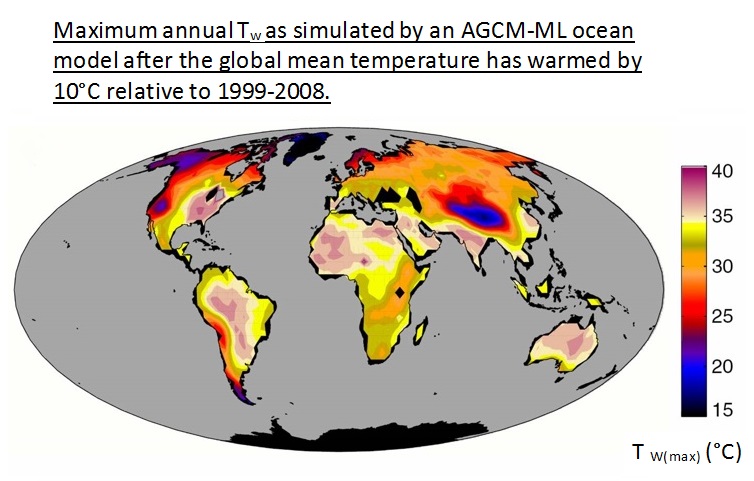
The wetbulb temperature (TW) is the lowest temperature of the skin that can be achieved through evaporation. Since the normal core body temperature in humans is 37°C and the skin temperature is 35°C, if the air temperature is greater than 35°C, the skin temperature can be kept at 35°C or cooler through perspiration. If the wetbulb temperature becomes too high however (because the air temperature is too high, the air is very humid, or a combination of both factors), it can be difficult for the human body to lose sweat through evaporation to cool itself. During this past decade, no where on Earth has experienced a wetbulb temperature of more than 30°C (which is acceptable considering 32-33°C is realistically the highest wetbulb temperature the human body can survive), but with the planet warming, higher wetbulb temperature maximums may become frequent, endangering the lives of many, particularly the elderly and the sick. Figure 2 below shows a worst case scenario where the climate sensitivity is high and minimum steps have been taken to reduce greenhouse gas emissions, resulting in a 10°C warming and wetbulb temperatures exceeding 32-33°C in many places around the globe, including the Middle East.


Figure 2.
Source: Sherwood and Huber, 2010. 


So according to climate models, the Middle East will get higher temperatures, altered precipitation patterns (generally leaning towards less precipitation), lower soil moisture and increasing wetbulb temperatures, all of which will decrease water security, food security, ability of the human body to survive and increase tensions over scarcer resources. If the current Syrian refugee crisis is indeed because of drought, we may see more climate refugees as water stress and food insecurity increase further, along with heat stress.

A note about the 2015 Paris Agreement

The 2015 Paris Agreement has been hailed by the many as a significant step forward against global warming and I've seen many of my own peers praising the agreement's decision that the global warming target should be a limit of 1.5°C rather than 2°C. But the reality is that even with the lowest, most optimistic greenhouse gas emission scenarios for the future, we're still looking to have greenhouse gases peak at the equivalent of a CO2 doubling. The climate sensitivity (the eventual global average warming for a fixed doubling in the concentration of CO2) is estimated with 90% confidence to fall between 1.5-4.5°C, so considering greenhouse gas concentration increases that have occurred so far are equivalent to a 75-100% increase in the atmospheric CO2 concentrations, we are already committed to a 1.5-4.5°C warming. Even if the climate sensitivity turns out to be low, a 1.0-1.5°C warming is far from safe, with eventual consequences including several meters sea level rise, widespread ecosystem damage and increasing drought and water stress (which we're already seeing with our current 0.8°C observed warming, as evidenced by the Syrian crisis above).

Thus the Paris Agreement's decision to limit warming to 1.5°C is not helpful to global warming efforts. We cannot just pick a number and say warming will stop at that number; it is nature and the climate sensitivity that will determine just how dramatic warming will be for a doubling in CO2 (or its heat trapping equivalent of greenhouse gases). The Paris Agreement would have done better to focus on encouraging all countries to reduce their anthropogenic CO2 or all greenhouse gas emissions to net zero by for say, 2060-2080. Indeed, the original draft text for the Paris Agreement planned to discuss reducing emissions to 0, but its removal shows obvious avoidance of disrupting current models of unlimited economic growth that use fossil fuels, while focusing on catchy numbers (1.5°C) to reassure the general public that the governments are supposedly doing the best they can.

Realistically, if we want to minimise the possibility of future large scale climate refugee migrations, we need to reduce emissions to net zero as soon as possible.

Friday, 1 April 2016

The GPA: The Canadian Student's Nightmare

In my second semester, I've come to understand more fully how the grading systems work in Canadian universities. Arts and Sciences degrees at U of T take 4 years, with students mostly taking 5 modules in the two yearly semesters over 4 years to add up to the required 20 credits to graduate. (Summer school, essentially a third semester, exists but it carries additional fees). For each module completed, the student receives a percentage which can then be turned into a Grade Point Value (GPV). The Grade Point Average (GPA) is then the average of all the GPVs, and is the score that defines how well you did in your degree. The table below shows a rundown of the marks:

Percentage
Letter Grade
Grade Point Value
85-100
80-84
77-79
73-76
70-72
A/A+
A-
B+
B
B-
4.0
3.7
3.3
3.0
2.7
Pattern continues down until F which is a fail
0-49
F
0.0


Basically with the GPA, every module that you take will be one credit towards your 20 credits to graduate. That means that if you fail a module or don't do that well in it, the mark will essentially "haunt you forever" (I'm using a phrase one of my Canadian friends used when explaining the system to me) as even if you retake the module, the original mark will still be recorded and lower your GPA. There is a credit/no credit system that allows students to take 2 modules (in total) that count towards the 20 credit graduation but not the GPA, although the catch here is that the no credit module cannot be a module required for the major you are enrolled in.

Having spoken with my Canadian buddies, I think I've decided that I prefer the UK degree system. The Canadian students are so terrified of taking a module that lowers their GPA that many tend to pick "easy" modules that they are more confident they can do well in. For example, one Canadian started taking an economics module only to drop the module in the first 2 weeks because they'd encountered slightly unfamiliar statistics material. The Global Warming course I'm taking is quite difficult and from an enrollment of 208 we dropped significantly in numbers after the first set of test marks when many decided they'd already messed up chances for a good module percentage; many of the remaining people in the Facebook group for the course wish they'd dropped it in order to save their GPA. One of my friends in the Global Warming course always wanted to do the course but took it strategically in his fourth and final year once his graduate applications were sent off so that if the GPA did  go down it wouldn't matter as much.

This is the problem: sure, the credit/no credit system allows people the choice of 2 modules that interest them without impacting the GPA, but overall, there is far too much strategic thinking in which courses to take, with the result being that many Canadian students take modules that are "easy", rather than modules that genuinely interest them. In the case of the person who dropped the economics module because of unfamiliar statistics concepts, the fear of the GPA stunted the broadening of their academic knowledge of concepts that they were probably perfectly capable of understanding. In this sense I like that UCL takes the median score as it means you do tend to take modules you're interested in, knowing that if you do badly in a couple of modules, your overall degree classification won't be affected by these outlier marks.

Another point is that at U of T, from the very beginning in first year, your modules count towards your final degree, with the same weighting as modules taken in all other years. While I do think the expectations of first and second year modules here are slightly lower than at UCL (having taken a number of second year courses here that seemed a lot less conceptually difficult than second year courses at UCL), the fact remains that students have to be on it from Day 1 in order to keep that GPA up. At UCL, they cut you some slack and first year counts for very little, allowing you to adjust to university life and learn how to write and think more academically without as much pressure.

Finally, just the idea of taking 5 modules each semester for 4 years is stressful! It's a lot of work (compare it to UCL where we usually only take 4 modules each semester!) and this workload intensity from continuous assessment throughout the semester is not helped by the anxiety Canadian students face in trying to not lower there GPA.

Overall, while the UK degree system has it's own challenges, I feel it is more conducive to learning and academic growth because there is not the same extent of fear as in the Canadian system.

Friday, 11 March 2016

Eastern European diaries: the question of meat

In the Balkans, where my family roots are, we eat a lot of meat. I've always enjoyed eating lots of meat and joked that it's all part of my cultural heritage: I wouldn't be a true Eastern European if I didn't eat it! However, the "Global Warming" course I'm taking at the moment has seriously made me reconsider my meat intake to the point that I have decided I seriously need to reduce it. Here's why...

Firstly, we all know the that cows produce methane when they fart. Why is methane so bad? Well:

1. methane is a greenhouse gas meaning it traps incoming solar radiation. A molecule of methane traps 25x the heat a molecule of CO2 does.
2. methane reacts with OH in the atmosphere which means HCFCs and HFCs (2 greenhouse gases with heat trapping abilities 1000s more times potent than that of CO2 or methane) last longer in the atmosphere because the only way to break down HCFCs and HFCs is through reaction with OH which increased methane depletes the concentrations of.
3. methane reacts with nitrous oxide (using energy from the sun) to produce ozone (another greenhouse gas).
4. some methane makes it into the stratosphere where it is oxidised to become H2O. H2O in the stratosphere is an especially strong heat trapper.

So methane is bad news. In terms of animals, cattle are the worst, with dairy cattle emitting 88kg per animal per year; beef cattle emitting 55kg per animal per year; sheep emitting 8kg, and pigs 1.5 kg, again per animal per year. Even though cows are significantly larger than sheep and pigs, one (beef) cow will still produce more methane than the number of sheep or pigs equivalent to the one cow's mass.

Estimated methane emissions per animal per year.
Picture sources: cow= The Guardian; sheep= Wikipedia; pig= animal-dream.com

Looking at overall greenhouse gas emissions from animal products in the bar graph below also reveals beef as the worst offender, with beef emitting 4 times the greenhouse gases than pork or chicken. Beef production emits lots of greenhouse gases because of the fossil fuels used for example to make the fertilisers to grow animal fodder; the enteric fermentation (cows farting); methane from manure; and nitrous oxide from manure (bear in mind that nitrous oxide is another greenhouse gas where one nitrous oxide molecule has 206x the heat trapping ability of one CO2 molecule). So this graph seems to suggest I should cut down on beef and sheep intake and if eating meat at all, should either eat pork or poultry.

Greenhouse gas emissions per MJ of food energy.
Source: Danny Harvey. 

The graph above also shows that, comparatively, eggs and dairy do not have as high greenhouse gas emissions, so it should be fine to keep drinking milk, right? Well, the next graph shows that compared to other drinks, milk production emits significantly more greenhouse gases per litre than any other drink. As such, I would do well to look into milk alternatives such as soy milk.

Greenhouse gas emissions per litre of beverage.
Source: Danny Harvey.

It's also important to consider the land needed to support these animals. There is almost 2.5 times as much pastureland as cropland in the world, and around half of this cropland is devoted to producing food for animals rather than to directly producing food for humans. Overall, the energy flows from crops (often corn) fed to the animals (including the inedible byproducts of the cropland) to the animal and then to the human consumer reveal an incredibly low efficiency of only 4%. Given meat consumption per capita is increasing globally and the human population is also growing, more and more land is being cleared (often deforested) for animal pasture and for producing the crops for the animals to feed on. With global warming expected to reduce agricultural yields, the rising demand for meat is worrying as we would need even more land to keep up with demand: in fact, decreases in agricultural yields due to adverse climatic changes could be fully offset by rather modest reductions in meat consumption. 

Overall, this (British-)Eastern European is going to aim to reduce her intake of meat, especially methane-heavy beef. I will also try to cut down on my dairy intake (even though it will significantly impact my hot chocolate habits) and most simply of all, I will try to reduce my food waste. My Slavic identity has always partly found expression in the food culture that emphasizes meat, but even though I now plan to eat less meat, I'm sure I can express my Slavic side in other ways that won't impact the environment so much.

Thursday, 3 March 2016

Leo's got the right idea

A post today about something that upset me. I was rewatching Leonardo DiCaprio's Oscar acceptance speech in which he talked about the serious threat from climate change, and in the comment section of the video I came across this comment (sadly with over 100 likes) from a global warming denier (apologies in advance for the comment's poor English):

"Explain climate change if no warming for 18 years? Explain the Chilean volcano injected co2 into the atmosphere in 3 days than the entire human race can in 5 years? Explain how co2 causes climate change by getting into the stratosphere when co2 is 1.5 tinea heavier than air, most stones still don't float on water. What percentage of the air is co2? You need to be able to answer all those questions before you have the right to call people that don't believe in climate change are idiots! Leo certainly can't answer them. Just because he's a celebrity doesn't give him the right to make erroneous claims, some some non celebrities might actually believe..."

I just want to answer each of these questions individually. First of all, "there has been no warming for 18 years". Yes, there has been a supposed global warming "hiatus" since 1998 where rates of surface temperature increase have slowed in comparison to model projections, but, to give the conclusion of one of my assignments for U of T concerning the supposed hiatus, overall longer-term trends of surface temperature increases due to anthropogenic greenhouse gas emissions mean the existence or non-existence of a short global warming hiatus is irrelevant. Recent research is also suggesting that there hasn't been a hiatus in the period 1998- until present, rather there simply appeared to be one due to a switching in the methods for recording surface temperatures that were calibrated slightly differently.

Secondly, the Chilean volcano likely being referred to here is the Calbuco volcano which erupted in April 2015. I couldn't find how much CO2 the volcano actually released, but regardless, as shown in the graph below, when the effects of volcanoes (as well as El Nino/La Nina effects and solar variability) are removed from models, the temperature trend from 1979 to 2011 across several different models is that of a steady increase, showing that it is indeed anthropogenic CO2 emissions that are causing the temperature increase, not natural variability.

Source: Foster and Rahmstorf, 2011. 


Thirdly, CO2 is heavier than O2 (not "air" as stated in the denier's comment, as air includes CO2, O2, N2 and a number of other gases and compounds). In the troposphere, there is enough motion in the air from winds (driven by temperature differences around the globe) to keep gases equally mixed together. Mixing between the troposphere and stratosphere mean CO2 can go up into the stratosphere where there are further circulation systems. Mixing takes a few years up to a decade yet CO2 has a lifespan of up to 100,000 years. The problem is that CO2 in the stratosphere tends to cool the stratosphere even though the troposphere and surface warm up. Given that rapid depletion of the ozone layer in the stratosphere begins when temperatures drop below -80°C, an increase in cooling stratospheric CO2 could worsen ozone depletion. Depletion of stratospheric ozone would lead to an increase of ultraviolet radiation reaching the earth's surface which would increase incidence of skin cancer, cataracts, and reduce yields in susceptible crops.

Fourthly, CO2 makes up a tiny percentage of the air, around 0.0314% . Indeed, water vapour is the most important contributor to the natural greenhouse gas effect (which helps keep the global mean temperature around 15°C instead of -18°C as it would be in the absence of an atmosphere). However, the point is that emissions of CO2 have the most important strengthening effect (see the pie chart below) because a) humans are emitting so much (the cumulative human emission of carbon up to 2014 has been around 560 Gt which is the same amount as was in the pre-industrial atmosphere; current CO2 emission rates from human activity are around 11GtC/year), and b) these CO2 molecules can have a lifespan of up to 100,000 years in the atmosphere (meaning each molecule can trap heat for a very long time after it is released).

Source: Danny Harvey, 2016. 


I hope I've "explained global warming" in relation to the above denier's questions and I hope the scientific community continues to try and break through the psychological barriers that stop people from taking action. Credits to Leo for mentioning climate change in his acceptance speech- it is so important that influential celebrities like him bring the issue to the forefront of public thought.

A quick note about my sources: most of the information comes from my study pack put together by Professor Danny Harvey for my Year 3 level course ("Global Warming") at the University of Toronto.


Monday, 22 February 2016

Canadian politics have never looked so good

Back in October last year, Justin Trudeau, son of former Canadian Prime Minister Pierre Trudeau, was elected Prime Minister, bringing to an end the era of Harper's Conservatives and ushering in new, arguably refreshing, Liberal politics. Upon election success, global social media seemed to quickly focus in on Trudeau's good looks and likability (check out his fall-down-the-stairs party trick). Personally, I remained on guard to see whether he was more than just a pretty face...

One of the first tasks of the job was to announce a new Liberal cabinet. Trudeau won praise for ensuring equal gender representation in his 31-Minister cabinet, with 15 of the ministers being women. Indeed, the cabinet is really rather delightful, with the Ministers often having more than just a passing link to their new position. For example, the Minister of Health is actually a family doctor, the Minister of Fisheries and Oceans, and Canadian Coastguard is Inuk (singular of Inuit), the Minister of Sport, and Persons with Disabilities is a former Paralympic medallist, the Minister of Science is a medical geographer (a graduate of geography from the University of Toronto like I will be!) and best of all, the Minster of Transport is a former astronaut (as such I expect his policies to include introduction of high-tech hovercrafts and segways to a Canadian street near you).

Trudeau's next high-profile activity was his pledge to accept 25,000 Syrian refugees by the end of February 2016. He even personally welcomed the first plane of Syrian refugees, saying " They step off the plane as refugees, but they walk out of this terminal as permanent residents of Canada".
His welcoming of the refugees was praised worldwide and also in Arab media, with Google Trends showing that searches for the word "Canada" in Arabic nations increased and even doubled in Jordan and Lebanon.

Trudeau further pledged to open an investigation into 1200 missing or murdered Aboriginal women and most recently, he will become the first Canadian prime minister to march in Toronto's Pride parade.

So far, Trudeau has presented himself well. I feel he has built a good image and is setting the tone for a new era in Canadian politics. Having said this, I also believe he has gone for the easy points and good PR. He has not really been tested yet, and I guess we have yet to see how he tackles the deficit and economy; integrating refugees in society; and any surprises the world throws at him.

Nevertheless, I like the renewed sense of open-mindedness that Trudeau has brought and I do look forward to seeing how his government progresses. It is also interesting to contextualize Trudeau in light of Donald Trump who is making huge gains in the race for the Republican nomination down in the USA. As always, Canada is very aware of events in America, and I get the feeling that many Canadians are really rather proud of their new liberal government, while critical and perhaps even embarrassed in their southern neighbour for the rising number of followers of Trump's dangerous xenophobic rhetoric.

Now please excuse me while I go place an order for a jumper of a majestic Trudeau on horseback...
Source: Shelfies


Tuesday, 22 December 2015

Reflections on Semester 1

Having finished my first full semester of studying at U of T, it is time to reflect on my academic experiences so far.

The first major difference between studying in the UK and in Canada is that the UK has a final exam system where everything from the whole year is tested in one exam period in May, whereas Canada uses continuous assessment throughout each term. Continuous assessment means there are a number of assignments, mid-term tests and a final exam all of which carry a small percentage weight of the final grade. For example, for my course "Geography of Canada", I had one assignment worth 20%, a mid-term and assignment worth 25% each, and a final exam worth 30% . By breaking up the potential for earning marks into these smaller chunks, it relieves the pressure of everything resting on one exam. Continuous assessment also forces students into studying, preparing readings and being more on top of things than in the UK system as you have to be able to draw on lecture and reading material for the assignments and mid-terms that come up every 2 or 3 weeks; whereas in the UK what tends to happen is severe cramming in the month leading up to final exams.

While it took me a while to adjust to continuous assessment (as you have to put in a lot more effort each week than in the UK where you can afford to slack off a little each week), I've come to really appreciate continuous assessment. I really feel I have learnt more by having the assessment broken down into smaller chunks as you do need to put in more effort to keep up; you write assignments and expand on lecture ideas when they are fresh in your mind and you are constantly building on that initial knowledge base. In the UK, I feel that no matter your best intentions, if you do not have incentives to do the readings and study (because of an upcoming deadline or exam), you tend to take it easy or procrastinate, leading to more stress and cramming in the long run. Furthermore, when it comes to exams, it's pressure-relieving going into the final exam here in Canada knowing you've got a significant proportion of the marks already in the bag, and I also like that the system of exams and mid-terms tests the whole course syllabus (compared to the UK where most students will strategically revise say 5 out of 9 topics for the final exam) as you end up with broader knowledge. In terms of stress, I'm not sure which system, UK or Canada, is better or healthier. In Canada, I feel there is a constant level of stress that is higher than the baseline stress level in UK since there is continuous assessment, but UK students undoubtedly experience greater spikes in stress level than their Canadian counterparts when it comes to the dreaded final exam season in May.

Certainly there are aspects of the Canadian continuous assessment I'm not as keen on: for example, a number of my courses have had multiple choice sections in the exams which I thought was not rigorous enough an assessment of knowledge. Some of my courses have also had class participation constituting 10% of the final course grade, meaning the more you participate, the higher the mark. This form of assessment forces you to engage (which is good) but also favours louder, more confident speakers, as well as sometimes seemingly forced, less-than-helpful contributions that are given just to try and increase the "participation" grade. I was particularly shy speaking up because I was conscious of my ridiculously English accent, and while I did end up participating to a certain level, this form of assessment was far from my favourite.

The other observation I have is that there does not seem to be as established a geography community as at UCL, even if there is a Geography Society. People in lectures sit far apart from each other and don't seem to know each other, perhaps reflecting the overall larger student population at U of T compared to UCL (85,000 compared to 30,000) but also reflecting the degree system of major and minors here that splits people between different disciplines. I have to admit I miss the relatively close-knit, supportive geography community from back in London.

My favourite course of the semester has definitely been Culture, History, Landscape. This course, while demanding in terms of the long reading lists, has really made me think about capitalism, the inherent social inequalities it produces, and the very different landscapes it has produced over time in different places across the globe since colonial times.

Saturday, 14 November 2015

Is Canada Really That Nice?

Internationally, Canada is perceived as a model state that is incredibly welcoming of foreign nationalities and immigrants. Yet researching the plight of foreign temporary agricultural migrant workers in Canada made me realise that Canada still faces issues of prejudice and discrimination against certain groups of people. The exploitative and coercive practices of Canadian migrant worker programs, as well as the racialisation of migrant workers within these programs and local communities leaves a lot to be desired.

What are temporary migrant agricultural workers?
Temporary migrant agricultural workers live in Canada for up to 8 months (depending on their contract), working in agricultural sectors including tobacco, vegetables and fruit (Bridi, 2013; Hennebry, 2008). The migrant workers come mainly from Mexico and the Caribbean states, notably Jamaica, and return to those countries once their contracts are over (Preibisch, 2004). The migrant workers are desired in Canada to help do jobs on farms that Canadian labourers refuse while the migrant workers are willing to come to Canada to earn wages higher than they would receive in their home country (Preibisch and Grez, 2010).

How are migrant agricultural workers exploited?
Mechanisms of control are used by the Canadian capitalist (at governmental, provincial, country and employer level) to  ensure a vulnerable and thus flexible labour supply (Bridi, 2013). Mechanisms of control include the fact that migrant workers are not legally able to unionise; employers threaten repatriation to the home country following poor work performance or creating "trouble" due to challenging the abuse of work and living rights; and employers attempt to limit the socialising and integration of migrant workers within Canadian communities in order to both leave the migrant workers with fewer social connections that could help with exercise of rights and to limit the number of friendly relations with Canadians that may influence migrant workers to stay in Canada after their contract ends (Bridi, 2013; Preibisch and Otero, 2014). 

Why does this exploitation continue?
Exploitation continues because of the racialisation and “othering” of the migrant worker (Preibisch, 2004). Racialization is evident in behaviour directed towards migrant workers by members of rural Canadian societies such as: crossing the street to avoid contact with black Caribbean workers; making racist comments or jokes; and even cases of violence and attack. Negative stereotyping of male Jamaican workers as threatening womanizers, or female Mexican workers as questionable mothers or sexually available, dehumanise the migrant worker and produce them as the “other” (Preibisch, 2004; Preibisch and Grez, 2010). By racializing and producing the migrant worker as the “other”, the migrant workers are excluded from the imagined rural Canadian community, thus legitimising exploitative and coercive labour practices as the migrants are not seen as equal to the Canadian citizens, and thus are not worthy of the rights that Canadian citizens enjoy (Bauder, 2005). Exploitation is not challenged because the migrant worker is the “other”, meaning exploitation continues.

Anything positive?
There have been some attempts to improve migrant worker experiences in Canada and challenge the exploitative conditions they face. In particular, migrant worker-Canadian citizen friendships formed in places such as church, in stores and in places of recreation are crucial links for assisting migrant workers in processes like money transfers, access to healthcare, legal help and emergencies (Preibisch, 2004). Community groups and civil organizations provide socially inclusive spaces for interaction and they also help with organising English lessons, legal workshops and advocating for migrants who do not speak up for fear of repatriation (Bauder, 2005). 

Conclusions
There is no doubt that temporary agricultural migrant workers in Canada are not granted the same worker and living rights afforded to permanent citizens of Canada. In particular, change at the local level would be instrumental. For example, promoting local awareness of the hardships endured by the migrant workers could help activate Canadian citizens to challenge destructive government discourses and legislation; the government would then be pressured into updating legislation and ensuring more worker rights as the civilian population becomes more watchful and critical.

Canada needs to challenge the coercive and exploitative relationships discussed above if it wants to continue along its path of creating successful multiculturalism and forging a role model country identity. Having said this, Canada still has a relatively successful model of  multiculturalism which will be explored in more depth in a future post about the role of multiculturalism in the Canadian identity.

Thursday, 22 October 2015

The First Americans

Since being in Canada, I have been learning a lot about the Native people of North America. A common question is “who were the very First Americans?” In other words who inhabited the land first? This question has important implications for modern day land claims in the Americas. In particular, I read an article from the National Geographic called “Tracking the First Americans”. In this article, the author Hodges asks the questions of who were the First Americans and how did they get to the Americas? In answering these two questions however, I feel some important issues arise…

The first issue is that of the western fascination with facial reconstruction of the First Americans. According to Hodges, one of the most exciting aspects about the discovery of the 12,000-13,000 year old skeleton Naia in Yucatan Cave, Mexico, was that the skull was intact enough to be used as a foundation for facial reconstruction. This fascination for facial reconstruction is possibly due to modern Westerners wishing to update geographical imaginations of Native people’s appearances. Yet it is interesting that the article asks why modern Native Americans “don’t look like their ancient ancestors?” Why should they look similar given 15,000 years of selective pressures and physical body changes over that time? Are we saying that our geographical imaginations of the First Americans and the modern Native Americans are the same? In which case, are we saying the modern Native Americans are just as “violent” and “wild-type” a people as their ancestors? 

Facial reconstruction of Naia.
Source: National Geographic
Secondly, the skeleton found at Yucatan Cave was named Naia after the water nymphs of Greek mythology. By using a western name, the scientists are essentially claiming this ancestral skeleton as their own. This feeds into old issues of colonial and Western power over the claims of the Native peoples themselves. Hodges also seems to suggest the First Americans were quite advanced people but he does this by employing western values of “advancement”, namely exploitation of natural resources and settlement in one geographical area, two factors which may differ from indigenous views on what constitutes an advanced society.

Thirdly, it is important to look not only at the scientific theories behind who the First Americans were and how they got to the Americas, but also at the moral issues of who should have the right to the skeletons (the scientists or the descendants of the skeletons) as well as how we are to refer to this skeleton that was once a live human being. Regarding Naia’s discovery, phrases like “her bad luck [in falling to her death in the cave] is science’s good fortune” could be interpreted as the scientists regarding this one-time human as simply a scientific object to study, while for many of the Native people, there is significant interest in giving the skeleton a burial in line with tradition for deceased relatives.  

When thinking about questions of who were the First Americans it’s all good trying to work out when and how they got to the Americas (as discussed in Hodges’ article), but it’s also important to think about why scientists ask the questions they do, and how those questions may reflect both desire for scientific understanding as well as historical oppression of Native Americans. 

Sunday, 11 October 2015

Studying in Canada: First Impressions

The first few weeks of the semester at the University of Toronto have flown by as I've started going to classes while continuing to explore the city and make new friends. I've now confirmed all my modules and have chosen two region-specific courses (Geography of Canada; Historical Geography of North America); a course to develop my GIS skills (GIS and Public Health); and two further topics of interest (Geographies of Social Urban Exclusions; and Culture, History, Landscape).

One of the first tasks of organising myself for the semester was ensuring I had all required books for my courses. For 4 out of 5 of my courses, the lecturer will provide online links to the readings which we can easily access. For the course GIS and Public Health however, there are two required text books that my lecturer cannot provide access to. Initially, I didn't think this was a problem as I assumed that there would be plentiful supply of the books in the library, like I'm used to back at UCL. But searching through U of T's library catalogue I found only 1 copy of the book "GIS and Public Health" and no 5th edition of the "GIS Tutorial for Health", with the 4th edition of that book not even being at the central St George campus, but out in the Mississauga campus. So I went down to the U of T bookstore to check out prices, finding myself just one of many students milling around inspecting textbooks. When I found my two books, I was duly horrified by the price and in disbelief asked one of the workers in the bookstore whether it was normal for Canadian students to have to pay hundreds of dollars for their own books. I got a cheery "Yep! Welcome to Canada!" as a reply. After considering changing modules to avoid textbook costs, I ended up forking over just under $200 on two textbooks, which I was not happy about. I am not impressed that on top of tuition fees U of T expects students to buy many of their own textbooks; it's unfair on students who cannot afford pricey textbooks, and you would think that with such a large student population (around 85,000 students) and fees, there would be enough money to adequately stock the libraries with all the books students need. Considering I've never had to buy a single textbook in 2 years at UCL, I realise now just how grateful I should be for the well-stocked UCL libraries. 

On another note, I started doing the readings for my course Culture, History, Landscape. One of the readings for the first week was a chapter by William Cronon "Bounding the Land" which looks at Native American systems of land and user rights, as well as how European colonisers brought a new set of cultural views of using land (based on land commodification and privatisation). The European colonisers didn't consider Native land use systems as legitimate and so justification of colonisation and dispossession of Native lands was based on taking over this "illegitimately" used land and making it legitimate under European values. While the chapter is in itself very interesting, I was amused by my own reading of it. In the chapter, Cronon refers to the Native Americans as "Indians" and it was the very first reading I did for this course so I didn't have much context as to what I was about to read. As I began reading about the "Indians" my geographical imagination was rampant in the country of India, but within 2 pages of increasing confusion, I found my geographical imaginations and understandings of the country India didn't match the landscapes and histories I was reading about on the page. I reread the start of the chapter, and while I had happily glossed over "New England Indians", somehow concluding in my mind that this was some newly colonised part of India, I suddenly realised the whole article was talking about Native American "Indians", not Indians from India. I found it interesting that my mind immediately jumped to the country of India even when it was glaringly obvious ("New England Indians") that the chapter was based in North America.

I feel this could be because the British school curriculum teaches the era of the British Empire in a way that perhaps still evokes national glory and success, with India being mentioned often and being portrayed as the poor country that Britain charitably helped develop. By contrast, the school curriculum does not devote much time, if any, to the Native Americans or what British colonisers did in the New World, perhaps because with limited time to teach history, there is a preference for teaching about the glory days of the British Empire rather than the colony Britain lost (upon the American Revolution). With my greater knowledge of the British Empire in India as opposed to North America (due to growing up in the British education system), it is possible to see how my mind jumped to India first. Regardless, this course is challenging my existing knowledge of the British Empire and it has already been enlightening to learn the extent of injustices in the British Empire, from the various ways in which India was exploited to the dispossession of land from Native Americans.
. 

Thursday, 1 October 2015

Algonquin Provinical Park: Beautiful Nature or Colonial Landscape?

The first month in Canada has been absolutely amazing; I’ve met exchange students from all over the world (as well as a couple of Canadians here and there), have enjoyed geography modules related specifically to the region (e.g. Geography of Canada; and Historical Geography of North America) and have travelled around Ontario and even ventured bravely into Quebec (unfortunately, 7 years of learning French still left me unable to decipher their accent *sigh*). 

When I initially came out to Canada this summer with my brother, we travelled around Ontario a bit before I went back to Toronto to settle in. One of the places my brother and I visited was Algonquin Provincial Park. This is a beautiful park, with huge lakes and lush woods of maple and pine. I revisited with the other exchange students a month later, where we camped, hiked and went canoeing. Magical moments from my trips to Algonquin include watching the chipmunks scampering about, seeing a black bear dash across the road, and lying in my tent at 3am listening to the howling of the wolves. Algonquin is an enchanting place where one can appreciate the beauty of nature and wilderness. And yet the question is, how natural is this landscape?  

Chipmunks are adorable! But do they live in a completely
natural environment...?

First of all, the forests of Algonquin are far from primeval. For the past 175 years they have been logged and burned to supply the large market for Canadian pine that arose in Britain in the early 1800s. As the market grew, more and more men went farther into the wilderness to cut more and more trees. Every spring, when the winter snow melted and river levels rose, the logs would be floated down to the big cities from where they would be shipped across the Atlantic. In fact, Algonquin was not declared a Provincial Park for environmental reasons, it was declared a Park to protect the capital interests of the white European settlers; Algonquin was simply a place to be exploited for timber and beaver fur for the fur trade.

Thus Algonquin is a landscape that has been transformed completely in the last 200 years. Physically, large old trees were cut down and logging infrastructure grew in its place: lumbermen huts, the railway, bridges and lookout towers. While many of these old railways and bridges are no longer in use, their remnants still litter the park, reminding us that this landscape was completely absorbed by the logics of capital introduced by the white settlers 200 years ago. Even today, most of the park is still logged; the landscape is thoroughly controlled by man.

Originally, lumber was floated down the rivers to the big cities 
during spring; the introduction of the railway meant faster, more 
reliable transportation that was not limited to one season. 
I would also like to suggest that the voices of the First Nation, the Algonquins, have been silenced in the Park. A number of trail guide books are available to pick up at each trail, yet the guide books focus on the ecology and geology of the Park, with the history of the Park starting with the early lumber industry. Who knows, maybe I just didn't do the trails that focus on the First Nations in the Park, but after my two trips, I can easily tell you all about the logging and the ecology, yet I know very little about the people who originally lived in and used the area.  Place names in the Park are mostly English, which, following lectures for my U of T course Culture, History, Landscape, feeds into one of the ways that the early European settlers dispossessed the First Nations from their land: laying land claims in territorial maps through the use of new place names and ignoring the previous names and claims. 

One example of this is a trail that goes past a section of a river known as Whiskey Rapids. These rapids got their name because near the turn of the 19th century, a group of log drivers celebrating the end of their log drive were trying to transport a keg of whiskey down the rapids from the railroad station. Two of the men decided to have a quick first drink while on their canoe but ended up drinking until darkness fell and they didn't see the approaching rapids. The canoe tipped and the keg was lost, thus explaining how the rapids got their name. While this is a fun story that gives insight into the lives of the loggers, it is an example of how the whole Park has been renamed by white European settlers to lay claim on the land by creating new, overriding histories in various different places.
Top section of Whiskey Rapids, Algonquin Provincial Park

In conclusion, there is no denying that Algonquin Provincial Park is a beautiful place. But let’s not pretend that this is a wholly natural landscape or that it represents a true Canadian wilderness. Rather, it is very much a colonial landscape utterly transformed by white European settlers. 

Wednesday, 16 September 2015

Welcome to Canada!

Hello there! So I'm currently on my year abroad in Toronto, Canada, and as part of this year, I am required to write a blog about my experiences and academic learning.

Before coming to Canada, I have to admit I hadn't thought about the country much nor did I know much about it. In fact, I chose Canada for my year abroad precisely because I didn't know much about it. When people think of North America, the focus tends to rest on the USA which is understandable given the domination of American culture around the world through television and music. But that's why the USA didn't attract me: even though I've never been there, I somehow feel I already know what to expect there because I've seen it on the TV so many times. By contrast, Canada is quieter, perhaps sometimes eclipsed by its dominant southern neighbour, but nevertheless still powerful in the global arena. I realised I wanted to learn about Canada, who the Canadians were, their place in the world and what it means to be a Canadian.

Other than sounding like a pub (and a great one at that), I called my blog "Maple and Moose" because before coming to Canada, those were about the only things I knew about the country. I knew that Canadians were partial to a bit of maple syrup, and I liked to imagine herds of moose roaming around vast expanses of romantic, untouched Canadian forest. This blog will hopefully document some of my experiences and enlightenment in Canada and North America.

A fun t-shirt I saw later in Montreal basically saying Canadians
are all about ice hockey, maple leafs and saying "eh?"